Étiquette : interdisciplinarité

  • Spiritual Forms : Notes For Thinking About Art and Spirituality

    Beyond contributing beautiful—or meaningful—objects to the public, art practice is a way for me to experience and think about the world, a way to understand the world and, through it, to understand something about humanity. This has always been the purpose of art-making for me: to experience in that way, to be conscious in that way, to be in that way. Striving for expressive perfection, for an always greater mastery of art-making and theoretical studies, for beauty and eloquence; venturing into aesthetically hazardous or philosophically contested terrain; and taking liberties with rules and definitions has served the essential purpose of developing more expansive knowledge and more intense experience.

    The framework for understanding art as a way of knowing and being in the world is not the same as a scientific framework. For this reason, it is hard to demonstrate this idea in a way that is comparable to how one would demonstrate a philosophical or scientific claim. Through sharing my personal and impressionistic thoughts, I hope to open conceptual ground for reflection on an artistic practice that is not striving to create so called “sacred art,” but is a way of enhancing a form of consciousness related to (or evoking) spirituality. Like Mircea Eliade (1959), I see spirituality as an inherent dimension of consciousness—and, essentially, as an experience of being.

    I present a framework where art—as a practice involving space, time and matter, as well as a practice related to consciousness and presence—shares some key features with certain spiritual practices. I do my best to define these very terms—consciousness, sacred, spiritual, meaning, matter, reality, and knowledge—as they appear in my work. I do not understand the notion of art in a romantic, idealized way. Rather, I see it as a practice entirely contingent upon context, materials and media, though not defined by them. In my view, art is a non-disciplinary practice of shaping time, space and materials (which could include intangible objects such as concepts and images, sounds, symbols, etc.) to create meaningful forms, objects and situations.

    Through art making, I experience an intensification of my consciousness and of the feeling that the world is meaningful. This way of being in the world and perceiving its underlying coherence—a coherence of which we are an integral component—brings about a sense of our presence and matter‟s presence. We perceive matter as living and vibrating, as no longer inert. We experience matter as presence, anchored in significance. This is an ontological perspective for which there can be no proof; no argument or discourse can make someone else feel it too. It comes from experience, the encounter with embodied and materialized work. It arises from contemplation rather than from observation and measurement.

    This form of knowledge is different from scientific knowledge or information. I see it as a form of gnosis, which in the Greek language refers to knowledge derived from intuition and recognition, as opposed to epistamai, which is a Greek word meaning knowledge derived from study and external sources of information (Bailly 1901, 173, 345). Similar descriptions of knowledge (as gnosis) are often seen in descriptions of how meditation elicits a feeling of unity and wholeness, of the integration of spirit and body.

    Living with the feeling that I am interrelated and integral to everything else is vital to me. It probably is vital to all of us, as the contemporary movement toward “reenchantment” would suggest.1

    There is a sense, indeed, that the lack of connection with the world and the loss of the sense of its underlying unity is the source of ecological disaster. I look for and cultivate practices that have the potential to enhance that sense of presence, meaningfulness and significance. Among such practices, art is the most effective for me: the process of shaping materials and sounds so that they become “art work” is my way of participating in the revelation of the world‟s coherence. Seeing or sensing an underlying coherence intensifies my intuition of the sacred, as well as my impression that my presence is ontologically founded.

    The sense of an “irreducible real” is how physicist Basarab Nicolescu defines the Sacred (1996, 183), while Mircea Eliade defined the Sacred as “the experience of a reality and the source of our awareness that we exist in the world” (2006). Enhancing my experience and awareness that I exist in a meaningful world is the primary reason that I make art. Abstract expressionist painter Barnett Newman argued that we should make work so that “if you stand in front of it, you know that you‟re there” (289). Art creates a sense of meaningful presence and connection.

    The relationship between artistic and spiritual modes of practice and consciousness is primarily apparent when we view it through an interdisciplinary art framework and a transreligious spirituality: the emergence of a concept of art beyond the specificities of the discrete disciplines and media, and a concept of spiritual experience beyond specific religious traditions, rites or practices.

    Aesthetic Meaningfulness and Spiritual Experience

    Many contemporary artists state that art‟s function is to create meaning. I once wrote: “The work of the artist, her « oeuvre » is beyond the object, in spite of the object‟s spectacular materiality. The object of art is an object of meaning” (Boutet 2002). Contemporary artists often call themselves “meaning-makers,” creators of “significant form” (Langer 1953). This is not meaning of the linguistic kind, but aesthetic meaning—aesthetic as defined by Merleau-Ponty, for example, in the sense of significant structures, of “contingent arrangement by which materials begin, before us, to have meaning” (Merleau-Ponty, in Kunzmann 1999, 197).2 An artwork does not transmit meaning in the same way that a word or a sentence does: it is not a codified signifier, an arbitrarily assigned symbol for something else, like a regular word. One can find coded signs or linguistic meaning in an artwork when the artist uses writing and/or cultural icons, but those signs alone do not comprise the artwork because its significance cannot be reduced to a reading of those signs.

    In the artwork, all layers of formal organization and all symbolic or material elements weave together to form a meaningful whole. It is an irreducible whole like a gestalt, which cannot be taken apart, said differently, or translated into another language or medium. The artwork is “meaningful” in that it generates a “field of significance,” somewhat like a quantum field, made of probabilities of meaning in which discrete signifiés coalesce and disappear: we know it is meaningful, but the interpretation of its meaning varies from one person to another and even from one viewing, or listening session, to another.

    What gives a work its artistic quality and strength is not its obvious subject or message, but rather its power to induce an experience of meaningfulness—its power to make us think and feel. When someone calls this experience “reading the artwork,” it is “reading” in terms of hermeneutics rather than semiotics: as an interpretation—a mental creation—rather than an actual decoding of the work‟s significance.

    Art is an example of how something can become meaningful, not by referring to ideas already formed or learned, but through the temporal and spatial arrangement of its elements. A film means in the same way as a thing means: not by speaking to a separate understanding but rather by addressing our power to silently decode people and the world and to coexist with them.

    Merleau-Ponty 1964, 1033

    As symbol of an inner experience, the artwork is a mediator between us and the world, an “intercessor” 4 establishing a powerful transaction between the artist, (a part of) the world, and the participants. It weaves a field of significance around us, a field that is generated and sustained by its vibration. This field of significance emerges from the combination of the artist‟s intention and invocation, and the materials and organizing principles operating in the work; but the actual meaning that the spectator “reads” into the work is really his or her own intrapsychic cognitive content set in motion by the work, a harmonic resonance. That is to say, it is influenced by his or her experiential, emotional and/or intellectual history. The content of the artwork is potential: the aesthetic work will activate the inner world of the spectator/listener/participant: his or her own affects, connotations and cognitive horizon. In that sense, it is not accurate to say that art creates meaning: rather, it creates the conditions for meaning; it enables meaning.

    Fortuitous natural designs (vegetal patterns, ocean rhythms, animal sounds, rock or cloud formations, etc.) also induce an aesthetic experience. This experience is essentially ecstatic: it is felt, apprehended through the participation of our full being, rather than read or understood rationally. It is experienced primarily as the result of being and contemplation—only then may it lead, or not, to analysis and reflection. This sense of being in a meaningful world, this sense of connection, is the condition for meaning.

    When making art, I look for arrangements and patterns that will produce this effect of meaningfulness and reality. According to Eliade, the sacred is “the source of our awareness that we exist in the world” (2006). Working with this notion of the sacred, I understand my process of creating aesthetic work as a spiritual experience. Because I set the parameters of my work to serve as parameters of a spiritual experience, and I am seeking to create a field of significance that has the potential to heighten consciousness and evoke sacredness, I am, in a sense, trying to engineer that effect in my psyche.

    A Personal Story: Mysterious Languages

    A recurrent theme haunted the poetry of my early years: that of voices speaking in the background of my consciousness, whispering most of the time but crying sometimes, in languages unfamiliar to me. This eventually led to my fascination with all languages and writing systems, all types of marks and symbols—charts, maps, mathematic symbols—from which meaning could be intuited.

    But in a peculiar way, I have been more interested in the state of fascination itself than in uncovering possibly hidden information. I have not tried to “read” these symbols, to decipher the symbols themselves. I have been more interested in listening to the impressions that the voices‟ whispering or chanting evoked in me and in being destabilized by the impossible reading of cryptic signs, in experimenting with a state of consciousness. To me, the “message” is related to the most important knowledge of all, knowledge that messages are hidden from us, that there is knowledge that will remain forever out of our reach, and that there is a world of mystery behind our familiar world. A great deal of my artwork has since been designed to contemplate that, to listen to the voices or witness their continuing presence. Listening is all that is needed because the essential part of the experience is to know, again and again, that there is mystery.

    So to remain connected to that contemplative and spiritual experience, I would trace signs and marks. I would transcribe those signs on paper or other media, investigate graphically their aesthetic qualities, and make images of them to acknowledge their existence. I have never tried to translate the messages because I have always been too aware that any interpretation of them would only be my own projection of rationality onto a mystery. Yet the fact that we cannot put such an intuition of mystery into words does not mean that such mystery is empty or that it is something in which we cannot participate.

    These unknown voices whispering in mysterious languages, which inspired my early poetry, came to represent, for me, artistic experience itself. All works, even figurative or narrative works, have an incomprehensible, abstract aspect behind their obvious meaning and subject matter: a pure design of relations, what Canadian artist Emily Carr calls a “portrayal of relationships” (1966, 54). If one decides to paint a scene or a vision instead of describing it, it is because a linguistic description would not convey this abstract dimension. If I compose music, it is because language cannot open the expanses of meaning that music opens inside us. If I make an artwork about a subject instead of writing a philosophical essay, it is because something about that theme eludes my analytical and discursive skills.

    Mind in Matter

    As matter intentionally shaped by a conscious mind, the artwork integrates the realms of matter and spirit and serves as symbol of, and witness to, the co-presence of that conscious mind and of that matter—and beyond them, of mind and matter, mind-in-matter and matter-in-mind. Beyond the singular object, it is the entire Mundus that is experienced as mind-in-matter. As Cézanne observes, “The landscape thinks itself in me and I am its consciousness” (quoted in Merleau-Ponty 1964, 17). This experience of our co-presence and of our being, through the work, the mind of matter is to me a mystical experience. It is a cosmological vision that is reminiscent of the Hermetic cosmology, which is based on the correspondence of the Universe (expansive and extensive) and the psyche (intimate and intensive). Through my composing, my obsessive processes, and all of my bricolage, my consciousness seeks to recognize something that would speak of/to its very presence, of/to the presence of matter, and of/to the presence of a unifying web of meaning. Matter is no longer solely material. Matter, sound, and space are steeped in meaningfulness, or significance, like an electromagnetic field. We weave such an encompassing field of significance through embodied and material practices like art-making, as well as through spiritual, magical, shamanistic, or alchemical practices. Renaissance alchemists looked at it as the “Unus Mundus” (Cazenave 1996); Jung discussed it as a “collective unconscious” (1968, 42-53); and Mircea Eliade viewed it as “the Sacred” (1959).

    Hence my work is about designing the parameters of a spiritual experiment through aesthetic experience. It seeks to weave a small area of the cosmic web within which spirit and matter are singularly related. It seeks revelation—revelation of what Paul Klee calls a “secret vision.” According to Klee, “not only do [realities of art], to some extent, add more spirit to the seen, but they also make secret visions visible” (1966, 51).

    Constructing the terms: threads through human history

    As an artist, I am drawn to ancient history and prehistory: images of some primordial humanity. Humanity as we think it might have been originally, whether based on scientific evidence or imagined or fantasized, evokes a poetic response in me. I enjoy looking at the unmistakable association, throughout recorded history and archaeological reports, between what I would call aesthetic practices (of which Western art is but one example) and spiritual practices. As a general category, aesthetic practices would include poetry; adornment; representation (of scenes, myths, heroes, etc.); storytelling and other narrative practices; costumes and masks; chants and music; dance; and theatre. It would be difficult to draw a definite line between what qualifies as an aesthetic practice and what does not, but I think I could reasonably define an aesthetic practice as a primarily non-linguistic practice aiming—through the handling, shaping, transforming and organizing of matter, living bodies, space, and time—at evoking impressions of meaning and feelings of understanding, and/or inducing sensuous experience. By spiritual practices, then, I am referring to practices related to consecration, sacralization, invocation and celebration: creating myths, performing rituals, praying, contemplating, entering a heightened state of consciousness, etc. Such spiritual activities involve many aesthetic practices; however, the two categories do not necessarily, or entirely, overlap.

    Interestingly, Western art is at once a paradigm and an exception among aesthetic practices. It is a paradigm because it is the product of generations of artists since the Renaissance who have focused on and experimented with the techniques and formal possibilities of a few specific media or Arts (those seven or eight that were to become the primary disciplines in Western art) and have brought these media‟s aesthetic potential to previously unthinkable extremes. And yet it is an exception insofar as such focus on the refinement of the medium itself, for its own sake, is relatively unusual among other cultures‟ arts, which have more typically developed in sync with the demands of the higher goals or the personages they were serving. In that sense, it would be ill-advised to generalize and apply what we know/think of Western art to other cultures‟ aesthetic practices. However, it is possible and necessary to acknowledge that, even though all cultures didn‟t have a concept for “art,” all cultures developed sophisticated artistic practices; had artefacts that could be qualified as artistic; and behaved in ways that remind Western people of their artistic attitudes: the most beautiful flint blades made by Cro-Magnon and Solutreans were not used but rather seem to have been kept aside and admired (Eccles 1989, 133), a behaviour that Western people could definitely consider artistic, or at least proto-artistic, since this precedes the origin of the concept of art.

    In the same way that Western thinkers should be wary of projecting their current concept of art onto aesthetic practices of the distant past, we should not impose a concept of “the sacred” that is just as culturally and historically determined. Eliade (1959) and Bateson (2005) both define the sacred as the integrative web of cosmic meaning within which a group or society lives its life and performs its functions. In certain archaic, preliterate cultures, where nothing was seen as separate from the sacred, there would be no point to constructing it as a specific dimension. As well, “sacred” cannot be a quality distinct from “profane” if nothing profane exists in a given culture. It seems to me that one needs to first recognize the co-existence and equal relevance of pluralistic religiosity and diverse religions before one can identify a dimension such as a transreligious sacred. There also needs to be a new secular dimension, emerging along with the socio-political and scientific spheres, for the sacred to become identifiable and to distinguish between sacred and profane sectors of society.

    Hence, the notion that in the past art and the sacred were not separate is at once true and false. A phrase such as “art and the sacred” is imaginable only when the two are established in opposition to a profane or secular sphere that is identified as non-sacred, and activities that are perceived as “not art.” Spirituality, on the other hand, is a more recent notion, having emerged in its current form only through a modern individual‟s ethos (Taylor 1992) and to a transreligious awareness, which takes place as people become aware of the diversity of religions and creeds. While we can use the term spirituality in many different ways relating to different eras and traditions, for contemporary seekers I would offer that spirituality could be defined as the quest for higher (possibly sacred) meaning of an individual soul, within or outside a religion, or through an individualized syncretism of many religious or philosophical traditions.

    It is only recently in the history of religions that spirituality and sacredness have become realities distinct from specific religious traditions and from problems of God and faith (Lenoir 2003). This has profound repercussions on everything that in contemporary culture relates to religion and ethics, which includes allowing us to see the potential of art—with its existential and experiential kind of religiosity—to become a spiritual practice in itself. Here, I am no longer referring to ancient notions of art of the sacred, but to contemporary art as it emerged from its modern and post-modern lineages (which includes its inter- and non-disciplinarity), and spirituality as defined through transreligious and non-religious contexts. I am speaking of how today aesthetic and spiritual practice may most convincingly converge in a new, or renewed, way.

    Homology between religious and hermetic knowledge and art

    Religious terminology has been used by artists in a more or less metaphorical sense since the Romantics, but this is not what I intend to discuss here. My interest in an “artistic sacred” began when, to my own surprise, the concepts of the sacred appeared to more accurately describe what seemed to be happening in my process, in the work itself, and in the many layers of transaction and mediation between the mind and the materials, the materials and the form, the work and the public, creation and reception, and so forth. Eliade‟s descriptions of sacred space and sacred time, in The Sacred and the Profane, appear to me to be the most accurate descriptions of what actually makes a musical moment different from an ordinary moment, a painted space different from ordinary space —and how to qualify that difference. What happens to time when the music begins, and for the few minutes that the piece lasts? This sense of being in a time outside of ordinary time, a qualified, multi-dimensionally structured and meaningful time within which a unique type of significance manifests itself, resembles greatly the sacred time that Eliade describes. The same applies to time in other arts such as theatre, film, performance, etc., as well as to space, a space outside of ordinary space, informed, dimensioned, etc. Eliade describes the structural patterns common to all religions beyond their specifics, and in doing so, he (apparently incidentally) happens to describe the spatiotemporality of art as well. Moreover, what emerges from my transversal reading of Eliade‟s work is the clear sense that Homo Aestheticus has the same type of consciousness as Homo Religiosus.

    Another homology can be drawn between the structure of art and alchemy—suggesting that alchemy, too, could provide illuminating concepts we could use to think about art. In reference to medieval cathedrals, Fulcanelli uses the phrase “dwellings of the philosophers,” that is, places and spaces where hermetic, esoteric, or alchemical knowledge dwells and can be found. The cathedrals are such dwellings, but actually they could be any small or large work, architectural monument, castle, church image, icon, object, piece of paper, remnant, detail, if knowledge is inscribed upon, or woven into, its very structure or form (1979, 45). Indeed, hermetic knowledge is most often expressed in aesthetic (graphic or symbolic) terms—like the Tarot for example, or other divination systems—rather than in discursive, explicit forms.

    It occurred to me that I could apply this concept to the artwork and see it, similarly, as a “dwelling”: i.e., a space, time, or site where knowledge or meaning “dwells.” This alchemical conceptualization of the artwork allows for a description of how invisible meaning, which cannot be articulated in discourse and is polysemic and open, may actually be actualized and materialized in matter and space-time. The artwork is not about “hermetic knowledge” per se, but it may be construed as containing knowledge in the same way as a hermetic text. Beyond their specifics, hermeticism, religion and art appear to share important structural features, among which is—most importantly, perhaps—the way they use space-time and materials to actualize a kind of meaning (or meaningfulness) that is open to interpretation and approached through hermeneutics and experience. Indeed, the containment and diffusion of meaning in an artistic artefact—or “dwelling”—points to a logical environment different from the rules of rhetoric governing the creation and transmission of scientific or discursive knowledge. This suggests not only a different kind of argumentative mechanics, but also a different kind of meaning altogether. Because artistic meaning is more a field of meaning than discrete entities of denotations codified in signifiers, I refer to artistic meaning as significance—or, as I have been saying, “meaningfulness.”

    Consciousness

    I see a vital relationship between this significance (emerging from art and aesthetic practice) and consciousness. There is an interesting circularity: consciousness can only exist in a field of significance and/or meaning, yet that field is generated by consciousness itself (Csikszentmihalyi 1990, 34; Low 2000). In systems theory, consciousness and meaning would be understood to be in a relation of mutual causality, or what Buddhists would call “dependent co-arising” (Macy 1991). This co-arising is actually a major spiritual event, nothing less than the continuing creation of the world. The interaction of meaning and consciousness and their mutual augmentation literally illuminates and enchants the world, which then starts shimmering with presence. Then things and beings start appearing as interrelated in all kinds of visible and invisible ways. This is how the impression arises of a world behind the world, or a depth dimension unifying the otherwise flat image of an inert, machine-like world.

    That we, human beings, might be weaving the world‟s primordial Chaos into a meaningful Cosmos (Eliade 1959) is reminiscent also of the Australian aborigines‟ “dream time,” their (continuing) creation myth according to which the world—originally dreamt by the Spirit—is maintained by the continued dreaming of all creatures (Wolf 1994, 140). What is created, in the dreamtime myth as in art practice, is not the material world itself, but our consciousness of it, through which the world appears whole. For Bateson and Bateson, what makes the world appear whole, that which they call “the pattern that connects,” is “the sacred” (2005, 8). Eliade considered the Sacred as an inherent structure in consciousness, even equating the experience of the sacred with consciousness itself5 —for there cannot be consciousness without a sense of connectedness. Hence, practices that increase this sense of a unifying connectedness also increase consciousness.

    Art and spirituality in our contemporary era

    In ancient time, human life is lived under the watch of the gods; everything the archaic mind perceives, feels, does, thinks and knows is unified within a great mythological narrative that accounts for everything under the sun and qualifies all things, beings and events (Eliade 1959). Ancient arts resemble our modern artistic disciplines in terms of the instruments, techniques, media and the specific spatiotemporal dimensions in which the aesthetic meaning is cast. Like today, sound, gesture, image, story, materials and costumes are employed to convey meaning—more often communal and cultural, however, than individual meaning. Yet in archaic societies, the arts, like science, religion, civil life and the socio-political sphere do not exist separately: the shamans and priests, the artisans, the architects, and the storytellers collectively weave the spiritual/cosmic fabric through word, magic, and aesthetic expression. All the crafts have spiritual/symbolic import at the same time as they are useful technologies (Eliade 1977). The resulting meta-narrative is the archaic sacred (Eliade 1959). This serves the essential function of integrating the world in the mind, of making it whole (Bateson and Bateson 2005). Art is made, but not for art‟s sake; for art doesn‟t exist as a discrete category of activity. Objects are made and activities are performed for the sake of that higher social/spiritual purpose (Bateson 2000, 128-152).

    In more complex societies based on literacy, the spheres are distinguished and progressively separated. The divine-based power of the clergy is separated from the secular power of the kings. At the same time, science, philosophy, technology and the arts become autonomous endeavours, and a disciplinary division of knowledge and practices occurs. When this is achieved—nowhere as completely as in industrialized societies—religion is a distinct sphere, fiercely separated from science and state affairs; philosophy is seen as distinct from theology; and the arts are autonomous and defined from within. But the reality of the world and of the human persons is not neatly divided into spheres. There is a higher unity beyond spheres of knowledge and social organization. To access it, dialogues are taking place: interdisciplinary research between social and natural sciences; interfaith meetings; scientific and religious dialogue; transdisciplinary conferences, etc. There are numerous attempts to reconstruct common ground and to potentially access the unifying level, to weave a synthesis.

    There is also a movement of synthesis within the spheres themselves. From the plurality of religions and the shards of religious traditions, a meta-dimension of “spirituality” emerges. Things, symbols, and ideas that before seemed unrelated or specific to a given culture or religious tradition are now understood as belonging to a common category of spirituality and spiritual experience. Our notion of the sacred and of spirituality is reconstructed, in a way, from elements of the religious traditions and philosophies; and the same is true of art: during the modern period, the concept of “art,” singular, was in fact, like spirituality, an abstraction. Instead of “art,” the Western model posited “The Arts,” discrete disciplines in which artists specialized, with little crossing or overlap: each of these arts was practiced, but no one was practicing “art” in general.

    But this finally came along, where interdisciplinary practice—and its consequent deconstruction of artistic disciplines—rests on the notion of “art” as a unified field of practice. From that unified place, it is easier to see the connections between art and other spheres: science, religion, or socio-political, economic affairs, etc. Currently, we see increasing collaboration between artists and activists; artists and scientists; artists and engineers; and artists and social agents. Artists who enter such collaborations tend to do so as “artists” in general rather than, more specifically, as painters or theatre artists for example. It is easier to collaborate outside of the field of art when you have a sense of what art is as a unified field, distinct from other spheres of knowledge and society.

    My own work is based on the intersection of art and spirituality, on the slice of common ground that they still share, after centuries of having been separated one from the other, and each within themselves: art separated into media-based disciplines, and the spiritual being entirely appropriated by religions and separated into faith-based traditions. But as Joseph Beuys (1988), Allan Kaprow (1993), and others have been saying, art is everywhere, not just in the institutionalized sphere of the Fine Arts. Likewise, Eliade, Huxley (1990), Bateson and so many others have pointed out that the sacred and the spiritual are not the exclusive dominion of established religions. I work within a context of art as a general and integrated category of practice and experience—i.e., ways of knowing, doing, being—beyond the rules of the disciplinary art world, and with spirituality as a sphere of practice and experience—beyond religions. Ultimately, this is how and why they are related in my work.

    I see myself as part of a long lineage, which, in my view, has its roots in prehistoric times. It is interesting to me that this lineage can only be inferred from my very contemporary perspective of artistic interdisciplinarity and transreligious spirituality. The possibility of even imagining a relationship between art and spirituality is entirely specific to contemporary Western culture. My words are contemporary, and so is the art that I make, as well as the way in which it is entirely devoted to the refinement of a spiritual revelation. Spiritual and artistic practices are old realities but relatively new concepts. That the sacred can be defined as a cosmic web of integrated meaning is also a new idea, although the reality to which it points is transhistorical. It is somewhat of a simplification to draw the conclusion that spiritual practice heightens the consciousness that creates meaning, and aesthetic practice creates the meaning that heightens consciousness; however this captures the essential link between art and the sacred with which I work in my studio.


    First published in: D. Cecchetto, N. Cuthbert, J. Lassonde and D. Robinson (ed.). 2008.
    Collision: Interarts Practice and Research. Cambridge Scholars Publishing.


    Works Cited

    • Bailly, Anatole. 1901. Abrégé du dictionnaire Grec Français. Paris: Librairie Hachette. http://home.scarlet.be/tabularium/bailly/index.html
    • Bateson, Gregory. 2000. Steps to an Ecology of Mind. Chicago: University of Chicago Press.
    • Bateson, Gregory and Mary Catherine Bateson. 2005. Angels Fear: Towards an Epistemology of the Sacred. New Jersey: Hampton Press.
    • Beuys, Joseph. 1988. Par la présente, je n’appartiens plus à l’art. Paris: l?Arche.
    • Boutet, Danielle. 2002. Territoires préhistoriques. In Esse Arts + Opinions. No. 43.
    • Carr, Emily. 1966. Hundreds and Thousands: The Journals of an Artist. Toronto: Irwin Publishing.
    • Cazenave, Michel. 1996. La science et les figures de l’âme. Monaco: Éditions du Rocher.
    • Csikszentmihalyi. Mihaly. 1990. Flow: the Psychology of Optimal Experience. New York: Harper Collins.
    • Eccles, John C. 1989. Evolution of the Brain: Creation of the Self. London: Routledge.
    • Eliade, Mircea. 1959. The Sacred and the Profane: The Nature of Religion. Harcourt.
    • ——. 1977. Forgerons et alchimistes. Paris: Champs / Flammarion Éditeur.
    • ——. 2006. L’épreuve du labyrinthe. Monaco: Éditions du Rocher.
    • Fulcanelli. 1979. Les Demeures philosophales. Société Nouvelle des Éditions Pauvert.
    • Huxley, Aldous. 1990. The Perennial Philosophy. Harper Perennial.
    • Jung, C. G. 1968. Collected Works of C. G. Jung. 2nd ed. Vol. 9. Princeton University Press.
    • Kaprow, Allan. 1993. Essays on the Blurring of Art and Life. Berkeley: University of California Press.
    • Klee, Paul. 1966. On Modern Art. London: Faber and Faber.
    • Kunzmann, Peter, Franz-Peter Burkard, et Franz Wiedmann. 1999. Atlas de la philosophie. Encyclopédies d’aujourd’hui, Librairie Générale Française.
    • Langer, Susanne K. 1953. Feeling and Form. New York: Charles Scribner?s Sons.
    • Lenoir, Frédéric. 2003. Les métamorphoses de Dieu : la nouvelle spiritualité occidentale. Paris: Plon.
    • Low, Albert. 2000. Créer la conscience. Gordes, France: Les Éditions du Relié.
    • Macy, Joanna. 1991. Mutual Causality in Buddhism and General Systems Theory. Albany: State University of New York Press.
    • Merleau-Ponty, Maurice. 1964. Sense and Non-Sense. Evanston: Northwestern University Press.
    • Nattiez, Jean-Jacques, ed. 2004. MUSIQUES: Une encyclopédie pour le XXIe siècle. 2 Les savoirs musicaux. Actes Sud / Cité de la musique.
    • Newman, Barnett. 1990. Selected Writings and Interviews. New York: Alfred A. Knopf.
    • Nicolescu, Basarab. 1996. La transdisciplinarité: Manifeste. Monaco: Éditions du Rocher.
    • Taylor, Charles. 1992. The Ethics of Authenticity. Cambridge: Harvard University Press.
    • Wolf, Fred Alan. 1994. The Dreaming Universe. New York: Touchstone.
    1. See, for example, Suzi Gablik, The Reenchantment of Art. New York: Thames and Hudson, 1991, and Morris Berman, The Reenchantment of the World. New York: Cornell University Press, 1981. ↩︎
    2. L’arrangement contingent par lequel des matériaux se mettent devant nous à avoir un sens (Merleau-Ponty, in Kunzmann 1999, 197). ↩︎
    3. C’est le bonheur de l’art de montrer comment quelque chose se met à signifier, non par allusion à des idées déjà formées et acquises, mais par l’arrangement temporel ou spatial des éléments. Un film signifie comme nous avons vu plus haut qu’une chose signifie : l’un et l’autre ne parlent pas à un entendement séparé, mais s’adressent à notre pouvoir de déchiffrer tacitement le monde ou les hommes et de coexister avec eux (Merleau-Ponty 1964, 103. My translation). ↩︎
    4. I use this word in the same way as Picasso is reported to have used it in the Trocadero, to express how African masks acted as mediators between this world and another, supernatural, dimension. ↩︎
    5. “What is this consciousness that makes us human? It is the result of that experience of the sacred, of that partition which occurs between the real and the unreal” (Qu’est-ce que cette conscience qui nous fait homme? C’est le résultat de cette expérience du sacré, de ce partage qui s’opère entre le réel et l’irréel (2006, 176). ↩︎
  • Le feu sacré : la pratique in spiritu

    Sylvie Cotton

    ÉCLAIRAGES EN FONDUS SUR L’ART ET LA SPIRITUALITÉ

    Sylvie Cotton est une artiste interdisciplinaire vivant à Montréal, au Québec. Sa recherche, amorcée en 1997, est liée aux pratiques de la performance, de l’art action, du dessin et de l’écriture, bien qu’elle fasse aussi régulièrement appel aux formes installatives pour la réalisation de projets d’exposition. Ses œuvres s’ouvrent sur la création de situations menant à l’instauration d’un rapport avec l’autre ou à une infiltration dans le monde de l’autre.

    Principalement, le travail s’inscrit in situ et in spiritu dans des lieux privés ou publics, et les résultats sont présentés dans des galeries et des festivals ou se déploient hors les murs dans d’autres types d’espaces publics (rue, ascenseur, parc ou restaurant, par exemple). L’activité de résidence est également utilisée comme un médium de création performative.

    Sylvie Cotton est aussi auteure et commissaire. Elle a organisé des événements, dirigé des publications et a été membre de nombreux groupes de travail et de comités en arts visuels. Elle a présenté ses projets de performance ou d’installation au Québec, aux États-Unis, en Italie, en Allemagne, en Serbie, en Pologne, en Finlande, en Estonie, en Espagne et au Japon.

    Elle a contribué cette réflexion sur la pratique qu’elle appelle in spiritu — c’est à dire une pratique où la dimension spirituelle éclaire l’ensemble du travail en atelier, autant la création que l’expérience du faire et de l’œuvre.

    www.sylviecotton.com/


    -1-
    devant l’âtre
    Le feu de l’écriture

    Une fois de plus, soumettre les intuitions et les expériences au feu du langage. Les mots sont parfois pires que tout ou mieux que rien. Ils ne parlent pas toujours en leur nom. Ils demeurent des signes-miroirs dans lesquels nous projetons, du creux du soi, vues, interprétations, peurs et espoirs. C’est avec ça qu’on écrit et qu’on parle.

    Ce texte rassemble des mots choisis et agencés pour parler de la pratique artistique de celle dont on dit que c’est moi. Je ne sais s’ils seront toujours vrais pour aborder ma recherche, mais pour le dire simplement, aujourd’hui, ils se trouvent où je suis. Cette recherche, je la pose comme étant à la fois intérieure et extérieure, spirituelle et artistique. Qu’il soit interne ou externe, l’atelier demeure un lieu intime de pratique et de réflexion (dans les deux sens du terme), un espace par lequel le travail de l’esprit rencontre, par frottement et répétition, celui du corps. Et c’est ainsi que le feu finit par y prendre. L’étymologie du mot atelier renvoie à un tas de morceaux de bois, et par extension, à la boutique de l’artisan. Ce soir, mes idées font les bras qui se penchent pour ramasser les fagots dans le grand champ de la conscience, le grand atelier. Et l’écriture, ah ! la belle créature ! Elle enfourne mes brassées de fagotins et y met de l’air, du souffle et telle une architecte, agence dans l’âtre les rondins à l’espace, la forme au vide. Le feu nécessite structure et attention.

    Quand l’attisée crépite, quand le feu murmure ses premières ondes orangées, son travail est engagé. Je sais à ce moment que ce sera un bon feu. Et je sais aussi que lorsque c’est mal parti, on ne peut pas tout reprendre à zéro, sinon on se brûle. Il faut travailler avec ce qui est là. La maïeutique de l’écriture fonctionne de même. Le dessin fonctionne de même. L’installation fonctionne de même. La performance fonctionne de même.

    Voilà. C’est parti. J’écris. Il me fallait mentionner leur manière d’advenir en moi pour que les mots se pointent sur la langue de mon esprit. C’est ce que je nomme pratique in spiritu. Ils m’ont maintenant en eux. Faudra en retrancher plusieurs en cours de processus. Mais avant de prétendre au résultat, quand il faudra qu’on pousse, on poussera, quand il faudra renoncer, on renoncera, quand il faudra laisser venir, on laissera venir. Et pour savoir ce qu’il faudra faire et quand, j’aurai le feu à l’oeil et le coeur dedans.

    -2-
    crépitements
    Le feu sacré

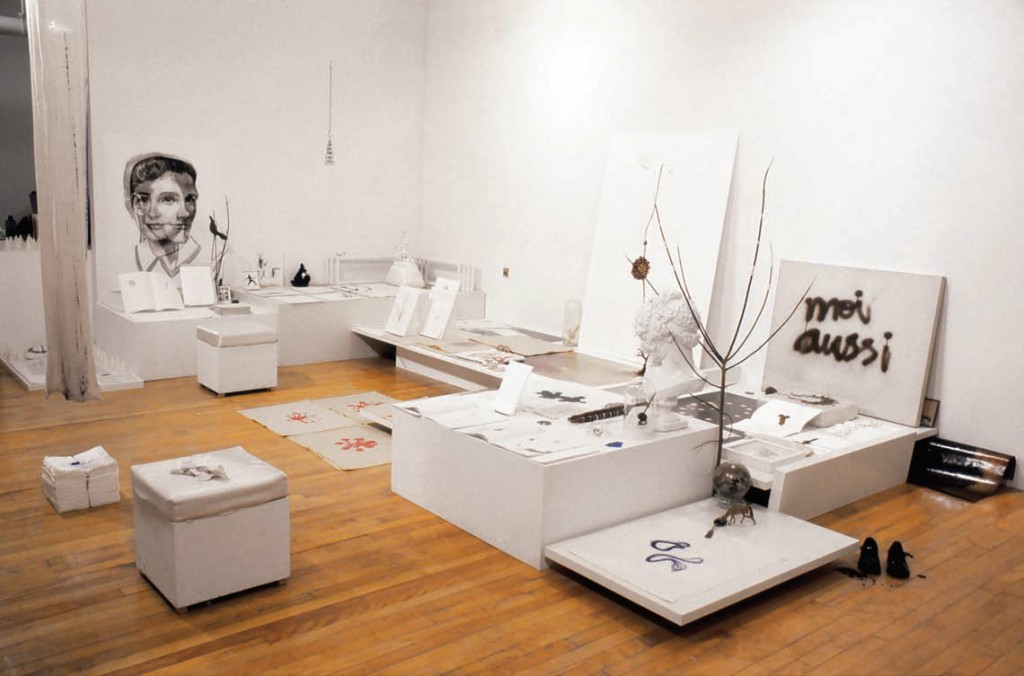
    M’étendre sur le sujet1 de ma pratique artistique, voilà ce que ce texte cherche à me faire faire. Il faut que je m’y allonge comme devant son feu, sa nécessité, sa chaleur (pour ne pas dire sa brûlure) pour sentir ce que faire de l’art veut dire. Mais aussi pour tenter de répondre – peut-être – à la question : pourquoi le faire ? Cela dit, ma pratique artistique étant de très près liée à ma pratique spirituelle, laquelle se manifeste par la pratique de la méditation, je ne pourrai m’étendre sur le sujet de l’une sans m’étendre sur le sujet de l’autre.

    Pourquoi faire de l’art ? Pourquoi méditer ? Pour nourrir un feu sacré. Pour nourrir le sacré. Et qu’on le veuille ou non, parce que le ça crée. (J’ai aussi été étendue sur le divan de la psychanalyse neuf années durant. Et je me souviens être passée du divan au coussin avec une aisance et un « timing » parfait.) Cela dit, même si tous les artistes ne prétendent pas à une pratique spirituelle, j’en connais peu qui ne traitent pas leur pratique artistique telle une « chose » sacrée justement, un espace sacré, un lieu sacré, ou qui oseraient démentir le respect qu’ils portent à leur propre démarche créatrice. Ce penchant appartient au monde de l’esprit et à une forme de quête, d’engagement, d’effort et de transformation. Pourquoi donc une pratique est-elle sacrée pour l’artiste ? Sa pratique le relie à la vie de son esprit, le garde en lien de communication avec son atelier intérieur. Cet aspect interne de la vie artistique, et qui la fonde, est inaliénable.

    En ce sens, il ne faut pas s’étonner de la résonance du sacré avec le thème religieux, puisque c’est par ailleurs la fonction de la religion, son étymologie dit : religere, relier la matière à l’esprit, la forme à la non-forme. La pratique artistique, une forme de spiritualité ? Sans doute. Intuitivement, je poursuis avec l’analogie du feu. Elle semble me faire dire que
    c’est l’élément qui, par frottement, relie le spirituel à l’artistique, l’esprit à la création. Selon le dictionnaire que j’ai sous la main en ce moment (je me trouve au Vermont dans un centre spirituel justement), la définition du feu serait « un phénomène consistant en un dégagement de chaleur et de lumière produit par la combustion vive d’un corps ».

    Combustion lente

    Le corps qui se consume est l’esprit de l’artiste offrant l’énergie et le fruit de sa recherche et qui, lorsqu’il se donne en même temps que son travail, fait effectivement se « dégager une chaleur et une lumière » qui peut aller jusqu’à l’exaltation pour lui/elle et les autres. En art performance, cette chaleur est doublée par le corps physique investi dans l’instant même de la création, qui est une offrande « on the spot », dans l’immédiateté et la simultanéité qui unit émetteur et récepteur.

    Mais pour arriver à cette union, à cette chaleur, il est nécessaire de pratiquer encore et encore. Il est nécessaire de répéter bien que sans répétition et avec fraîcheur. Patience. Confiance.

    La pratique in spiritu

    Comme pour l’engagement sur la voie spirituelle, l’aventure artistique consiste à entrer dans l’atelier intérieur. En fait, on pourrait dire que c’est une vie comme les autres, en ce sens qu’elle consiste à se pencher sur une tâche et à s’y familiariser. Dès lors, qu’est-ce qui la différencie et lui donne une aura magnétisante ? On imagine les artistes libres alors qu’ils ont une grande responsabilité.

    En effet, plus j’y retourne et me remets à l’ouvrage, plus je constate que c’est un drôle de métier. On dispose d’un espace-temps pour s’occuper de quelque chose qui ne possède pas encore de forme (et parfois jamais), que personne ne demande à voir sauf d’abord soi (et même pas toujours), qui n’est ni fonctionnel ni nécessaire, mais qu’il est essentiel de faire naître et de voir apparaître devant soi, pour enfin le donner, et le plus souvent, animé
    d’une vibration viscérale pas toujours confortable. Cela vient du doute, du dévoilement, mais aussi de l’arrachement à l’atelier. L’extraction et la transplantation demandent en effet un lâcher-prise. C’est très généreux. Pour couronner le tout, l’expérience est le plus souvent traversée et vécue en solo. La grande solitude. Même quand on veut la partager, elle ne se livre que partiellement. Impossible de rendre la texture de la traversée. Et ce qui rend cet étrange cheminement encore plus solitaire, c’est que les autres sont en fait toujours présents, en soi, comme en rêve. Des fantômes d’influences, de supporteurs ou de critiques. Bref, une assemblée de surmoi dont on apprend à s’affranchir – c’est le processus. Cette solitude est profonde parce qu’elle donne le pouvoir de se reconnaître seul et en connexion.

    La pratique artistique se développe à travers une attention à ce à quoi l’esprit cherche à donner forme (idées, intentions, expériences), grâce à une vue (orientation, démarche, manière, style). Ensemble, ils manifestent une présence et un corpus de plus en plus raffinés et libres, finalement offerts et parfois exposés.

    Pour le dire autrement et pour employer des mots que j’ai déjà écrits ailleurs, l’art consiste à montrer ce que l’on cache. L’art consiste à révéler sa nature humaine. L’art consiste à chercher la justesse et non à intimider les autres. L’art consiste à se laisser raffiner par la vie. L’art consiste à inspirer le monde. Puis à l’expirer. L’art c’est comme l’amour, c’est difficile.

    Quant à la voie spirituelle, elle consiste à se laisser distiller par la vie, à entrer en rapport avec son esprit et à s’engager par ce rapport à développer une curiosité intime pour ses propres états intérieurs (surtout ceux qu’on préfère le plus souvent ignorer) et pour les manifestations extérieures que ces états entraînent. Vivre, travailler et composer avec cette matière, comme avec une matière à modeler, et faire de son existence une œuvre d’art. Autrement dit, créer sa vie à partir des matériaux que l’existence nous donne. Aussi, tenter l’aventure en regard du moment présent. Y voir et y établir sa demeure, son refuge. Et pour y arriver, renoncer aux espoirs comme aux peurs. Le défi est grand. Les fruits délicieux, car ils libèrent des attentes et des espoirs.

    Les étapes de la voie se déploient à travers une présence attentive et consciente à ce que manifeste l’esprit (émotions, névroses, idées, comportements) et à la façon dont il accueille ces manifestations (méthode, lignée, voie, forme – nommée aussi religion), produisant, progressivement accrue et libre, une présence authentique de manière organique, spontanée, épiphanique.

    Bref, la pratique in spiritu, en complément à celle in situ, consiste en un va-et-vient entre l’atelier intérieur et l’atelier extérieur, entre la forme et l’informe, entre le spirituel et le séculier, entre la vie et la vue. Au bout du compte, les voies spirituelles et artistiques fournissent des rencontres incessantes avec les phénomènes, incluant sa propre incarnation comme phénomène.

    Fusion

    J’assistais récemment à une conférence sur la spiritualité et la sexualité, et j’ai trouvé très intéressant qu’y soit soulevé le désir d’union en tant que trait commun aux deux domaines. Je crois que la pratique artistique partage aussi ce désir d’union. Elle le porte secrètement ou plutôt ne le nomme pas ainsi. Le désir de se rapprocher d’une qualité de vérité intérieure et de la transmettre, le plus souvent, en créant une forme. Et cette forme n’est-elle pas produite en état d’union avec ce qui cherche à apparaître ? C’est exactement ce que je nomme pratique in spiritu.

    Dans tous les cas, il semble qu’une dimension supplémentaire trouve grâce par les pratiques : l’union est double. En effet, artiste, amoureuse ou moniale, la personne qui pratique souhaite unir à la fois sa réalisation à la vue de son propre esprit, mais aussi à l’esprit de l’autre. Elle veut rejoindre l’autre, lui transmettre quelque chose. C’est une offrande. Il ne s’agit pas de convaincre, mais bien d’offrir une vue intime, manifestement ou secrètement.

    Comme l’a exprimé Alain Fleischer lors d’un récent colloque tenu au Musée d’art contemporain de Montréal sur le thème Art et religion2 : « C’est la vie spirituelle qui permet la vie artistique. » Je crois que le passage peut aussi se présenter à l’inverse : la pratique artistique ouvre la voie de la pratique spirituelle. Menée en pleine conscience, la voie artistique dévoile une sagesse intrinsèque, stimule une prégnance en l’instant présent. Des révélations en apparaissent une à une, doucement. Mais, en définitive, je n’aime pas vraiment faire ces distinctions et comparaisons. Alors, dès maintenant, je cesse de commenter les deux positions – artistique et spirituelle – comme si elles étaient différentes, et je les fonds l’une dans l’autre, là, maintenant. Voilà. Fusionnées. Grâce au feu de l’écriture.

    Alchimique.
    -3-
    embrasement

    Étudier son esprit est déjà un acte créateur.

    Quand on se tient dans le vent qui circule entre les questions et les réponses que la pratique nous soumet, on est lié à ce qu’on fait. C’est si bon. Et c’est si beau. Et je crois même que la beauté de l’œuvre commence par là – voire même qu’elle en dépend –, c’est-à-dire par la liaison intime entre l’artiste et sa question, laquelle devient son trésor. On est encore dans une dynamique d’union. Une dialectique naturelle à l’être humain chercheur de lumière. L’anagramme ESPRIT-PISTER le démontre de manière amusante : l’un est déjà dans l’autre. La recherche est la raison d’être de l’esprit. On est vivant pour chercher la lumière et absorber ses vitamines existentielles.

    S’abreuver aux fraîcheurs fondamentales de la pratique suppose de porter ces questions. Elles sont très simples, car elles sont concrètes et s’impriment dans la vie, pas à pas. Chacune se résume en un mot: Qui, Quoi, Comment, Où, Quand, Pourquoi. Toute pratique repose sur leur fondation. C’est pratique la pratique ! Absolument terre-à-terre. En les transposant dans l’atelier intérieur, j’ai vu comment m’expliquer à moi-même la résonance des raisons d’être de la pratique. Des pratiques. La pratique artistique et la pratique spirituelle. En y répondant par la voie du schéma (une approche semblable à celle de la carte heuristique) on peut trouver une voie, sa voie. La voie de sa pratique.

    On naît tous des autres

    Qui est là pour pratiquer ? Un soi bardé de peurs et de désirs. Peur de quoi ? De sa propre force et de sa propre faiblesse. Désir de quoi ? D’expression et de reconnaissance. La projection contient à la fois l’héroïque et le peureux. L’expérience oscille entre ces deux états. Qui vit tout cela ? La pratique engage une dimension de recherche sur ce soi qui travaille avec soi toute la journée. Pour y arriver, il paraît essentiel de déposer son esprit dans son esprit, d’être là et de s’accompagner. Présente !

    Mais l’esprit est la partie du soi qui a le plus de mal à comprendre la réalité parce qu’il est aux prises avec ses idées fausses car fixées. Pour s’assurer d’entrer réellement en contact avec son esprit, il est incontournable d’entrer en relation avec la partie du soi qui croit tout ce que réfléchit l’esprit et qui veut solidifier son identité ou sa position. Cette vue sur la pratique artistique m’a été transmise par une de mes enseignantes de l’art Shambhala, Tanya Tree : « L’art consiste à entrer en relation avec son ego3. » Autrement dit, il est nécessaire d’entrer en contact avec ses peurs et ses espoirs en envisageant clairement comment l’esprit s’y prend pour diffuser ou masquer l’effet de ces émotions. En fait, on doit absolument s’entraîner à rencontrer les phénomènes intérieurs comme extérieurs si on veut saisir leur qualité d’apparence.

    La voie spirituelle est là. La voie artistique également. Cela dit, un artiste peut réaliser des œuvres magnifiques au regard de l’histoire de l’art, sans savoir qu’il a une vie spirituelle, sans la nommer ainsi ou sans en vouloir. Pourtant, plus on s’y intéresse, plus on constate que chaque être élabore une vie spirituelle. Seul son degré d’activité varie. Tout esprit a donc le pouvoir de se montrer intègre et de contrer la confortable ignorance qui le garde loin du déroulement de sa vie. Sa force se tient là : être authentique et s’offrir comme présence authentique. Ce qui a pour résultat de faire fuir l’ego qui n’a plus de raison d’être. Son combat est inutile, voire ridicule. L’esprit ainsi ouvert (et on pourrait dire le cœur ainsi ouvert) amène à prendre parole pour oser révéler ce que l’on apprend sur soi et sur le monde, et qui est toujours et avant tout intérieur, comme un rêve. Cette réalisation reste commune à tous les êtres. En ce sens, on est tous la même personne. Et au final, un même grand esprit chercheur. En conclusion, travaillent au moins trois entités qu’il est important de reconnaître et de connaître: le soi qu’on croit être, celui qu’on ignore (et qu’on est), puis celui qu’on croit qu’on doit être. C’est déjà beaucoup. C’est avec ça que je travaille, avance, tâtonne, cherche, recule et saute.

    Mais il y a plus dans une présence à l’œuvre. Il y a les autres. J’appelle ici en exemple le projet que j’ai présenté à la Biennale de Montréal au printemps 2011, sous le titre On naît tous des autres ou Sapience. Le projet consistait à transformer en confettis l’ensemble de mes notes de cours et textes photocopiés étudiés pendant mes études à la maîtrise en muséologie. Le résultat avait pour effet d’unir pour toujours la théorie et la pratique, ma théorie et ma pratique, et de fonder en mon travail toutes les pensées et leurs auteur-e-s comme un geste irréversible célébrant l’union des êtres en la création. Car ils sont toujours là : idoles, émules, collègues, compétiteurs ou complices. Ceux à qui on veut plaire, ceux à qui on veut répondre, historiquement ou non. Ceux avec lesquels on veut partager. Ceux qu’on aime et ceux qu’on craint. Ils sont là dans l’atelier du soi qui cherche à pratiquer la nature de son esprit. À y voir clair. Et pour y voir clair, il ne peut que reconnaître sa propre projection du pouvoir, qu’il accorde à l’illusion de la division. L’altérité est bienfaisante et bienveillante et elle désaltère quand je la laisse me prendre. Au contraire, elle devient obstacle si je la redoute et m’y oppose. C’est ce qu’on appelle le doute sur la voie spirituelle. Et le doute, s’il est passif et écrasant, a pour effet de voler confiance et dignité. Il brouille les perceptions et éteint la lumière. Alors, le  feu s’étouffe. Le résultat est le même en création. S’il n’est pas vu, reconnu, regardé ou interrogé, le doute assassine. Je ne parle pas ici du doute ressenti envers autrui ou envers une forme théiste, mais envers son propre potentiel à s’épanouir dans l’ouverture et à la lumière de son ouvrage.

    -4-
    quelques braises

    Voici des éclats de lumière, tisons et brandons, de ce que la pratique me fait. De quoi cela parle-t-il ? D’intimités de toutes sortes.

    L’espace de la pratique

    La pratique procure un espace possible de dilatation dans l’atelier du temps, de dissolution dans l’atelier du soi, et de transformation dans l’atelier du coeur. Ce qui revient à dire que quoi qu’il arrive ou se présente à l’esprit ou sur la grande table interne de l’atelier, la pratique l’inspire puis l’expire. Tout est matériau pour la pratique et toute forme peut devenir une forme en transe. Une forme en transition. L’atelier intérieur représente l’espace de la pratique, son coeur et le mien. Exactement. S’y trouve tout ce dont j’ai besoin. Le fait d’y entrer ne garantit pas de succès extérieur mais promet un effet intérieur de réalisation.

    S’abandonner à la pratique : perdre connaissance

    La pratique nous amène à faire ce qu’on n’a pas appris à l’école. Même à l’École des Beaux-Arts. (En passant, je ne suis pas allée à l’École des Beaux-Arts.) Comment apprendre à faire comme si on n’avait pas appris ce qu’on a appris ? On a besoin de changer de vue. Il s’agit d’être sans connaissance. De la perdre. Et perdre connaissance c’est m’abandonner à l’inconnu en croyant que l’inconnu prendra soin de ma présence. La foi n’est-elle pas tout simplement cette confiance fondamentale en la suite des instants, en la force fantastique de l’existence ? Accepter de passer de l’état de stabilité à celui de recherche pure menant à une déstabilisation, et ce faisant, voir que l’art n’est autre qu’une union entre le possible et l’inconnu, entre le temporel et le sacré. C’est la pratique secrète dans l’atelier intérieur. Aucun autre espace n’est plus vaste ni aucune autre action n’est plus transgressive. Je crois que tous les artistes la connaissent. Chaque artiste croit-il que ce secret est le sien ?

    Esprit de corps

    Il y a déjà cinq ans de cela, j’ai commencé un autre texte sur l’ensemble notionnel que convoque le corps artistique : signature, comparaison, compétition, pudeur, identité. Maintenant que la pratique m’a fait pratiquer et m’a fait voir que le soi est plus grand que soi, il serait peut-être temps que je le termine. Car se laisser prendre par l’espace qui englobe tout a cet effet merveilleux : on se sent plus petite que soi et plus grande que tout.

    La peur de pratiquer

    La pratique nous rapproche de la vérité. C’est pourquoi elle nous fait si peur. On a du mal à s’y engager parce qu’on sait qu’elle nous fera perdre nos illusions. C’est sa fonction. Pourtant, l’existence même nous place déjà dans cette situation par le passage obligé de la naissance, de la vieillesse et de la mort. Mais nous ne voyons pas que notre vie est une pratique. Nous la voyons comme la répétition pour une générale qui viendra plus tard. Elle ne viendra pas. Jamais. Le spectacle se joue aujourd’hui. À l’instant. Toujours. La peur de pratiquer la page blanche, l’atelier neuf, le canevas vierge. Tout cela est la peur   du vide, de la vacuité. La peur de ne pas savoir quelle oeuvre on fera, quelle vie on mènera.

    La chorégraphie de l’intuition

    Autre principe à l’oeuvre dans la pratique : la danse de la recherche intuitive et spontanée. Cela demande de prendre sa place. Vous direz mais chez soi, ce n’est pas sorcier. Dans son propre atelier, c’est sans souci. Faux. Même chez soi, il peut être difficile de céder la place que sa pratique veut prendre. Des signes ? Le corps se soulève et s’oriente sans but. Il devient pure énergie. À une présence consciente, il dira tout de ce que l’esprit est en train de connaître : l’énergie sexuelle, la satisfaction dans le processus, le doute dans la recherche, la rencontre avec le vide, l’exploration entre vacillement et découverte, l’acceptation de l’inconnu souverain.

    Sylvie Cotton

    -5-
    mort du feu

    Les flammes ont monté, puissantes, et maintenant presque étouffées, avec moi essoufflée, nous sommes prêtes à devenir fumée. Paraît que les feux deviennent vieux aussi et qu’ils doivent mourir. C’est Bachelard qui en parle dans Psychanalyse du feu. Pourquoi faire de l’art ? Pour apprendre à vivre. Pourquoi méditer ? Pour apprendre à mourir.

    C’est l’heure de fermer les ouvertures. De mourir à ce texte et à ses propositions. Le moment est venu de replonger dans un nouveau monde, celui de la page blanche. Mais puisque tout est déjà là et qu’il ne s’agit que de patiemment l’extraire et de le parfumer de ma sueur de chercheure, je suis tranquille. Voilà la pratique : une douce pratique de la présence. À soi. À toi. Dans la grande solitude du vaste ensemble humain.

    1. M’étendre sur le sujet est le titre d’une de mes expositions, présentée en janvier 2006 à la Galerie Joyce Yahouda à Montréal et qui offrait un foisonnement d’oeuvres, d’objets personnels, de fragments ou de matières d’atelier et d’écriture, et dont la thématique consistait à tracer des liens entre différentes notions liées à la figure de l’artiste et au corps artistique (signature, identité, doutes, influences). ↩︎
    2. Alain Fleisher, « Traces du religieux », communication prononcée dans le cadre du Colloque international Max et Iris
      Stern 4 Art + religion au Musée d’art contemporain de Montréal (du 15 au 17 avril 2010). ↩︎
    3. L’Art Shambhala est un enseignement du Vénérable Chögyam Trungpa, Rinpoché, (1940-1987), fondateur de Shambhala International, de l’Université Naropa, et figure marquante de la transmission en Occident du bouddhiste tibétain. L’Art Shambhala est une vue et une pratique issues de la méditation et par lesquelles se révèle toute la puissance de l’esprit créatif lorsqu’il engage directement ses perceptions dans le vif du monde phénoménal. ↩︎
  • Le jardin du collège américain

    Le jardin du collège américain

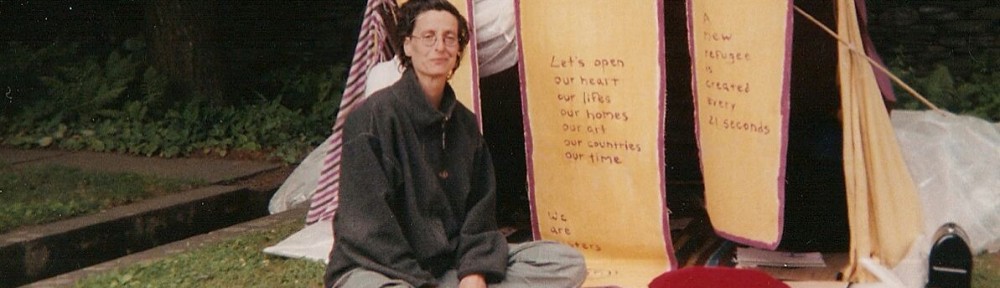
    Suzanne Boisvert devant l'une de ses installations.

    Suzanne Boisvert est une artiste en communauté intègrant la pratique relationnelle. Elle vit à Montréal et travaille actuellement sur un projet collectif, Nous, les femmes qu’on ne sait pas voir, une exploration intergénérationnelle du vieillissement.

    Elle fait ici le récit d’une rencontre émouvante, vécue en 2001 dans le cadre d’un projet relationnel au Goddard College, au Vermont.


    C’est le mois de juillet. Deux mois avant le 11 septembre 2001. Je suis aux États-Unis. Au Vermont. À Plainfield. Dans les jardins victoriens de l’université Goddard. On m’a invitée à venir parler de ma pratique engagée lors de la résidence d’été du MFA in Interdisciplinary Arts. Ma proposition sera une performance-installation-conversation sur trois jours.

    Le point de départ, de lancement, de ces trois journées, c’est le mardi soir. Je présente une première performance au manoir, Conversations. Diapositives, dispositif scénique simple et adapté au lieu, script écrit pour plusieurs voix, car j’ai demandé à deux étudiantes volontaires de se joindre à moi dans l’espace, et à un autre de faire tinter une cloche à toutes les 21 secondes. Je « conte » ma trajectoire d’engagement en partant du présent, en partant du projet dans lequel je baigne depuis un an, Détresse et Tendresse, a broken heart is an open heart. Quelque part entre le storytelling, le stand-up, la conférence et un espace de conversation. Je fais le récit des liens entre ma vie personnelle, artistique, activiste. Je fais des liens entre le thème de «prendre refuge» et l’état de réfugié. Des liens entre ma mère Alzheimer qui vient d’être placée dans une institution, elle qui m’avait sortie de mon institution lorsqu’elle m’adopta. Des liens entre tout perdre, tout laisser derrière soi, condition partagée par des millions de gens sur la planète. Je raconte ce que j’ai laissé derrière moi pour arriver à rejoindre ma mère et toutes les personnes vivant dans un état de conscience altérée. À travers les mots de la performance, la cloche tinte, elle rappelle que toutes les 21 secondes, il y a un nouveau réfugié quelque part sur la planète.

    J’ouvre donc mon cœur pour entamer une conversation avec les membres de cette communauté présente sur le campus. Une conversation que je souhaite poursuivre durant trois jours, jusqu’au jeudi soir, 24 heures sur 24 puisque je vais installer mon « campement artistique » rudimentaire dans les jardins. J’invite tout un chacun à venir me voir, me parler, dessiner, danser, prendre le thé, méditer avec moi. Tonglen Garden. Du mardi soir au jeudi soir, je tiens donc « salon » parmi les fleurs et les arbres, avec des éléments d’installation provenant de mon appartement montréalais, altérés pour l’occasion.

    Je ne sais pas du tout, en lançant cette invitation, si j’aurai effectivement des visiteurs. Aucune espèce d’idée de ce qui se passera, se dira, se vivra. La seule chose sur laquelle j’ai un certain « contrôle », c’est que j’ai pris le risque d’ouverture lors de la performance initiale. Je me dis : je demande aux gens de s’ouvrir, de se lancer, d’oser venir vers moi, de prendre des risques… la moindre des choses, c’est d’en prendre moi-même dès le début et espérer que mon cœur ouvert, ma main et mes bras tendus soient reçus comme un début de conversation. Que les gens perçoivent ma sincérité, en dehors du côté « art conceptuel » d’une telle démarche. Suis-je seulement dans ma tête?

    Car le plus grand risque pour moi, c’est que personne ne vienne me visiter. Que je passe ces trois journées comme une tarte dans un four ! Que finalement, ce que je propose soit rejeté, que toute cette performance ne soit qu’une vue de l’esprit et non pas une offre du cœur, que cela ne rejoigne personne. Que je ne touche personne. Que tout ça reste de l’art conceptuel qui se veut relationnel mais qui n’est que conceptuel…

    Suzanne Boisvert

    J’ai eu très peur durant la préparation. Une sensation qui me prenait parfois à la gorge quand je préparais les éléments de l’installation ou quand je me projetais dans cet inconnu. Quelques jours avant de partir pour le Vermont, j’étais allée visitée Jeanne au CHSLD Jacques-Viger à Montréal – une dame que je visitais régulièrement depuis l’automne précédent, avec qui j’écoutais de la musique, je parlais, je restais souvent silencieuse à quelques pouces de son visage. Jeanne était aveugle, en fauteuil roulant, très âgée et elle vivait dans un niveau de conscience altérée. Mais elle était tellement «présente». C’était une des mes « teachers » pour Détresse et tendresse. Je suis donc allée la voir. Je lui ai demandé de prier pour moi. De me donner du courage parce que j’avais peur. Je lui ai expliqué pourquoi. Elle a tenu ma main entre les siennes. Jeanne. Elle était très certainement avec moi, la belle Jeanne, pour veiller sur moi… car ces journées sans pluie passées dans les jardins de Goddard sont peut-être les plus belles de ma vie.

    Tonglen Garden. Un jardin, du temps, pour «donner et recevoir». Tout fait tellement de sens. Chaque minute. Chaque fleur. Chaque mouvement des feuilles dans les arbres. Chaque visage qui se tourne vers moi. Chaque bribe de conversation. Chaque rencontre avec des inconnus… Mais qui est donc l’« Étranger » ici? C’est comme si nous l’étions tous, donc que personne ne l’était. Nous sommes tous et toutes de passage dans le territoire des dévas du jardin.

    Des femmes, des hommes, des enfants, beaucoup de gens ont pris refuge avec moi dans ce territoire pour un court moment ou pour une longue conversation. Des étudiants, des professeurs, des employés de cafétéria ou du registraire, des artistes, des écrivains, des visiteurs qui passaient par là par hasard…

    De toutes ces rencontres je retiens celle-ci en particulier. Car j’y ai vécu une réelle communion, un moment de grâce, un moment que je n’aurais jamais pu imaginer vivre. Lin Chuan Chu est un artiste accompli, formé dans la tradition classique chinoise. Il vit à Taiwan et a décidé de faire son MFA aux États-Unis. Il me semble jeune pour un maître de sa discipline. Il est beau. Il m’apporte du thé chinois et je mets de l’eau à bouillir sur le petit bleuet de camping que j’ai apporté. Chuan Chu m’offre un petit catalogue de ses peintures; sur chacune des pages vierges, il a calligraphié une longue dédicace en caractère chinois. Il me traduit. C’est une réponse à la performance que j’ai faite mardi soir. Une phrase l’a bouleversé, dit-il, « my mother is dying ». Il vient me parler de sa mère, de sa famille, de sa vie à Taiwan. Il me dit qu’il fait cette maîtrise pour intégrer quelque chose de plus personnel dans son travail. Nous buvons lentement notre thé bouillant, assis à la petite table de prière que j’ai confectionnée pour l’occasion. Nous sommes assis sur mes longs coussins rouges. Il y a des oiseaux dans les grands arbres, un écureuil qui traverse les dalles en courant. Il y a le vent léger qui fait bouger les feuilles. Il y a le soleil légèrement voilé par les nuages. Il y a cet homme qui vient de si loin et moi qui lui suis si étrangère. Et pourtant… Nous sommes assis ensemble dans cet instant suspendu. Le temps n’existe plus. Les frontières non plus. La langue est autre. L’anglais est notre no man’s land, notre terre d’accueil, notre point d’intersection pour quelques instants. Et Chuan Chu se met à chanter a cappela. Un extrait d’opéra classique chinois du XIIIème siècle, me dit-il. C’est comme un rêve tellement c’est étrange, so unlikely to happen. Et pourtant… C’est en même temps tellement incarné, d’une telle beauté impossible à reproduire. Ça me fait presque mal, comme chaque fois que j’expérimente l’essence de la beauté. De la poésie. Du vivant. Du cœur. Ça fait mal, comme la morsure du réel dans un monde que je ressens si souvent sans consistance, cauchemardesque, so upside down.

    Le silence habité du jardin revient. Les dévas sourient. Jeanne aussi.

    Nous nous prenons dans nos bras, Chuan Chu et moi, nous nous serrons un moment sans rien dire.

    Nous nous quittons.

    Je reste assise longtemps. Ce nous ne me quittera plus jamais.

  • The Alzheimer’s Method of Art Making

    The Alzheimer’s Method of Art Making

    Painter and intermedia artist Annie Abdalla tells about her caring for Joan, her mother, and the effect it had on her art making.
    Painter and intermedia artist Annie Abdalla tells about her caring for Joan, her mother, and the effect it had on her art making.

    Annie Abdalla have an MFA in Interdisciplinary Art from Goddard College and a Masters in Environmental Studies from York University; She has also studied interdisciplinary art at Naropa University and the Nova Scotia College of Art and Design. Since 2004 she has been on faculty at Goddard College in the Individualized BA Studies program. She lives by the ocean in Nova Scotia with her furry companion of many years, Miss Maddie.


    As a child I spent lots of time looking at the ceiling wondering what a room would look like upside down. This informs my current practice in that my paintings often defy still life traditions by releasing conventional notions of weight and space.

    The common artifacts of life – the kinds of scenes or objects that are so commonplace that they become somehow invisible over time, that’s what really seduces me. I often explore for months, or even years, with the same shapes, as if in an ongoing dialogue. These investigations are shaped by contemplative practices that cultivate the ability to perceive with fresh eyes each time. My years of training in Shambhala Buddhism are woven into the work.


    As an interdisciplinary artist who, like most artists in Canada, also has a second job. I share with many artists that daily struggle to juggle my other paid work with my arts practice and try to share the manifestations of my creative activity with others as often as possible. In the recent past I’ve had some good invitations to exhibit and publish.

    But my already complex formula for pursuing my art and paying my bills was altered for five years as I spend part of each year caring for my mother, in her 90’s, who had Alzheimer’s. I shared this job with my sister, each of us taking turns every few months. I moved from my home in Nova Scotia to spend about six months a year in Sherbrooke Québec.

    Maintaining a rhythm in my art practice, turning my mind to the work each day, was always well…up and down. In the beginning I was responsible for my mother’s daily physical care but as her needs increased and her health deteriorated, it was clear that we had to find more help. Fortunately we found an excellent place for her in a nursing home, but my siblings and I all agreed that we would continue to support her quality of life by being here with her every day.While I was in Sherbrooke I had to make-do with studio space that has sometimes in a spare bedroom, and sometimes is just a kitchen table. After a few failures I managed to choose my projects according to the space I had available.

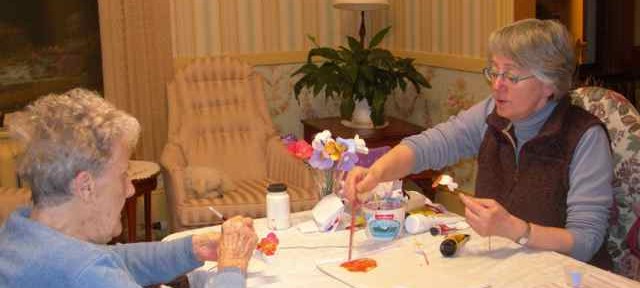
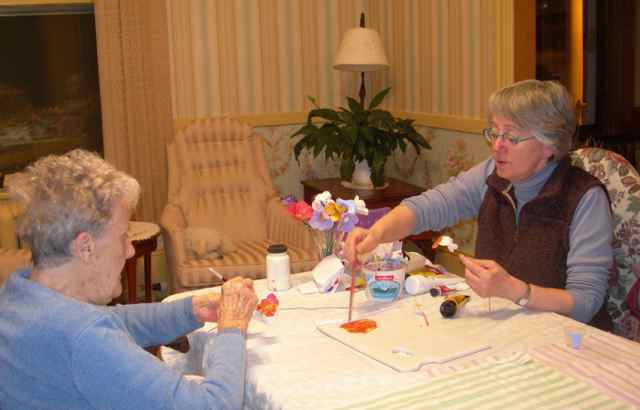
    But as I struggled to maintain my arts practice I was been blessed with an auspicious “artful experience” with my mother. She never remembered what she had for lunch, but could still “make with the hands”, and in fact, this is what still made the most sense to her. Every evening when I visited her we went to the living room and set up a little card table and did craft projects. We played music that she could still remember from the years of WWII and we sang along, and every so often we get up to dance to a favourite tune.

    We stencilled wooden trays, made fabric books using iron-on adhesive, and made dozens of plaster cupcakes with lovely spackle icing and sprinkles for the nursing staff. We painted flowerpots, built clay vessels, and made boxes in which to deliver cookies to friends. She never remembered a project that we’d done so I could bring the successful ones back over and over and she loved them just the same.

    The things that we made were nothing like the art that I make in my own studio. But something really surprised me about how all this time doing “handicrafts” has affected my own practice. Somehow this daily experience of making with the hands has kept the system “greased” and I have experienced a particularly good flow of artistic energy. I’ve had some rather fruitful years even.

    I liken this experience to my parallel practice of Shambhala Buddhism and the years that I have spent training my mind to have a kind of attention to the moment. Central to that practice is the notion of path with no goal, something that is quite foreign for our Western minds that are always making plans, setting objectives and striving for goals. I have spent many years cultivating the skill of paying attention to my own body, speech and mind. This is the primary frame of reference I have for the concept of a practice – it is something worth doing even when the immediate results are invisible. It takes patience, and a release of the idea of always “getting somewhere” or “producing something” and it requires regular engagement.

    I have recently come to understand that at its core my art practice has a physical experience that is irreplaceable. I cannot simply think about making art and then go into the studio and do it – I need to train my body in order to be able to come back day after day to this kind of engagement. I need to keep the “art blood” flowing, the system greased. What has really surprised me is how effective these crafty projects have been as a training path. I’m beginning to understand that it doesn’t matter how I cultivate that flow – eventually something interesting will catch fire in my heart and my hands and new work that challenges and pleases me will emerge.

    Would I be satisfied to just paint flowerpots for the rest of the year – probably not. But I’ve came to really appreciate the quiet time that I had with my mother watching her have successful cognitive experiences. In this situation I simplified the environment as much as possible, I tried to pay attention to what was happening in the moment without judgement and, most importantly, I slowed down. The outcomes, the things we made, were inconsequential, and are largely forgotten. We let go of them without attachment.

    When I returned home to my own studio space I found myself brimming with new ideas and ready to work. Like an athlete who has been training for the day of competition, I have a muscle memory of how it feels to be making something and paying attention to the process.